

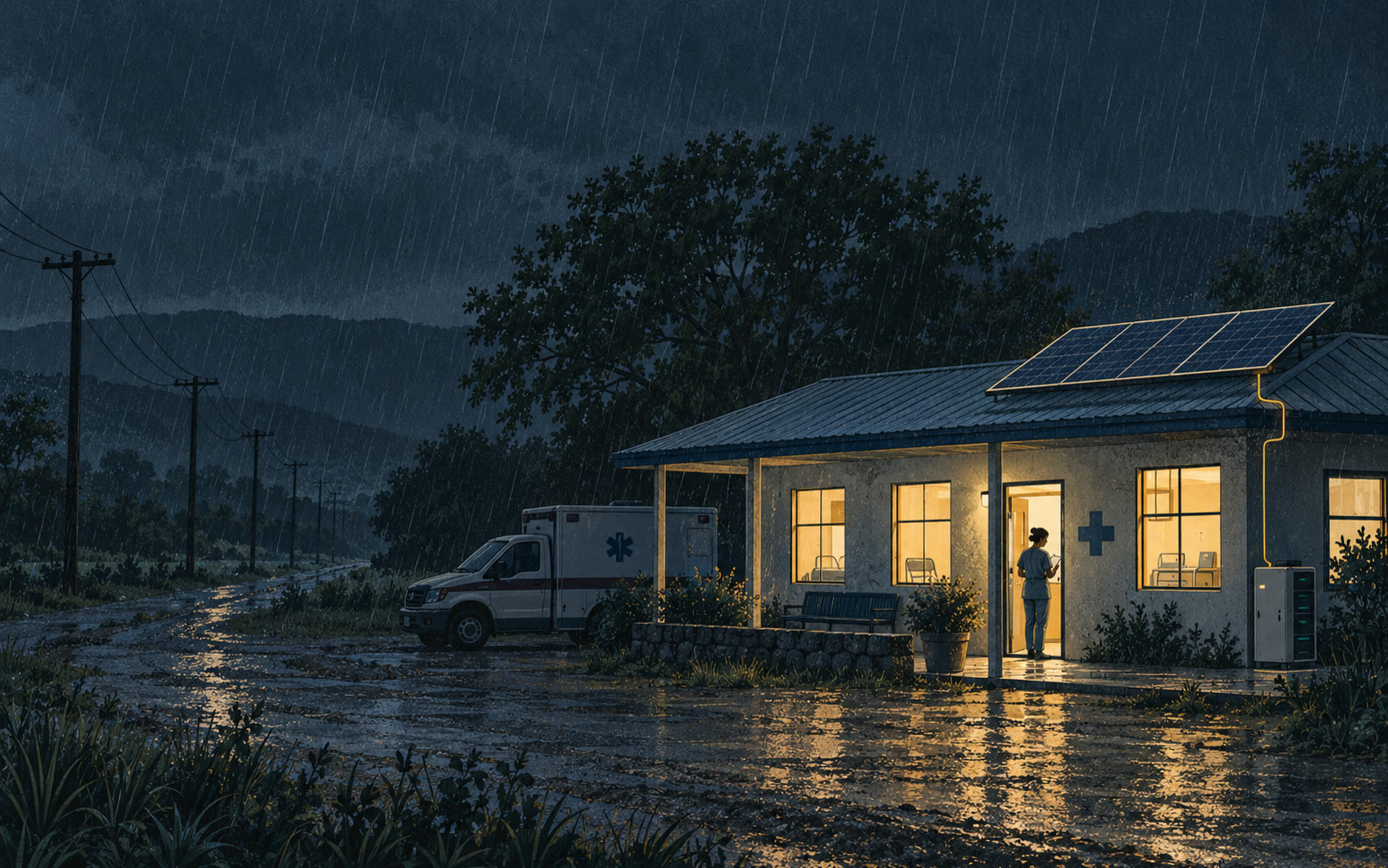
When Hurricane Helene tore through the Southeast in September 2024, it didn’t just knock out power. It dismantled the systems that keep communities alive. In South Carolina, the average customer went without electricity for 53 hours. Across ten states, 6 million people lost power. In rural Georgia, 71% of farmers lost access to water wells—not because the wells were damaged, but because the pumps that draw water from them need electricity to run.
The lesson is brutal in its simplicity: when the grid goes down, everything that depends on it goes down with it. That includes the clinic that stores vaccines, the shelter that houses displaced families, the water treatment plant that keeps taps flowing, and the controlled-environment agriculture facilities that grow food year-round. The question isn’t whether the next storm will come. It’s whether the lights will stay on when it does.
The grid wasn’t built for this
The American electrical grid was designed for a different era—one with fewer extreme weather events and less demand for continuous, reliable power. In 2024, U.S. electricity customers experienced an average of 11 hours of outages, nearly double the annual average of the previous decade. Hurricanes accounted for 80% of those lost hours.
The Texas experience is instructive. During Winter Storm Uri in February 2021, 48% of the state’s generation capacity went offline. Four million households lost power, some for days. At least 70 people died—not from the storm itself, but from hypothermia and carbon monoxide poisoning as families tried to stay warm without electricity. The crisis cascaded: water pipes burst, and 12 million Texans were placed under boil-water advisories because treatment plants lost power. The economic toll reached an estimated $85.8 to $128.7 billion.
This is what grid dependence looks like in an age of climate extremes. A single point of failure becomes a community-wide catastrophe.
What a microgrid actually does
A microgrid is a localized energy system that can operate independently from the main utility grid. It typically combines a power source—solar panels, a generator, a fuel cell, or even a small nuclear reactor—with battery storage and an intelligent control system. When the main grid fails, the microgrid “islands” itself and keeps critical loads powered.
The distinction matters. A backup generator keeps a single building running. A microgrid keeps an entire ecosystem of critical services running: the hospital, the water treatment plant, the shelter, the fuel station, the communication systems that coordinate emergency response—and the controlled-environment agriculture facilities that feed the community.
The Blue Lake Rancheria tribe in northern California demonstrated this during regional power outages. Their solar-powered microgrids kept internet and phone service operational, maintained water and wastewater treatment, and kept fuel pumps working so first responders could refuel. The grid also powered a local hotel where eight people with acute medical needs were relocated.
That’s the difference between surviving a storm and maintaining a community through one.
The clinic problem
Healthcare facilities are uniquely dependent on electricity. A modern hospital requires power for heating, cooling, life support, medical equipment, refrigeration for vaccines and medications, and the water systems that support sanitation and treatment.
The data is sobering. A 2023 survey found that 60% of Florida health centers lacked backup power. Only 40% could maintain refrigeration for temperature-sensitive vaccines during an outage. Power outages cost Florida health centers an average of $41,000 per day in lost revenue.
For clinics and community health centers, the stakes are even higher. These facilities often serve populations with limited access to care and may be the only medical resource in a rural area. When they lose power, they don’t just lose revenue—they lose the ability to serve their community when that community needs them most.
The water connection
Water and power are inseparable. Pumps move water from wells to treatment plants to storage tanks to homes. Wastewater treatment requires continuous aeration and processing. Without electricity, the entire water cycle stops.
During Winter Storm Uri, the power failure became a water failure. Pipes burst, treatment systems failed, and millions were left without safe drinking water. In rural Georgia after Helene, farmers had to truck water to cattle because electric wells couldn’t operate.
A microgrid that keeps a water treatment facility running is not a luxury. It is the foundation of public health during a disaster.
The food security crisis nobody talks about
When the power goes out, the conversation usually focuses on lights, heating, and medical equipment. But there is another crisis unfolding in the dark: food production stops.
Controlled-environment agriculture (CEA) facilities—greenhouses, vertical farms, hydroponic and aquaponic systems—depend entirely on electricity. Pumps circulate nutrient solutions. LED grow lights supplement natural sunlight. HVAC systems maintain temperature and humidity. Sensors monitor pH, nutrient levels, and CO2 concentrations. Filtration systems keep water clean. Without power, a CEA facility doesn’t just stop growing—it begins to die.
The timeline is brutal. In a hydroponic system, roots can begin to suffocate within hours without oxygenated water flow. In an aquaponic system, where fish and plants depend on each other, the loss of circulation can kill fish stocks within 24 to 48 hours, collapsing the entire ecosystem. Temperature-sensitive crops like lettuce and herbs can wilt within hours if temperature control fails. And in a greenhouse, without ventilation, temperatures can spike to lethal levels for plants in minutes on a sunny day, or quickly damage plants on cold days.
After Hurricane Helene, rural communities in Georgia and North Carolina faced not just power outages but food supply disruptions. Roads were washed out. Distribution centers were closed. Grocery stores that relied on just-in-time supply chains emptied within days. For communities that depend on local CEA operations for fresh produce, the loss of those facilities meant the loss of their primary food source.
This is the hidden vulnerability. A community can survive a few days without power. It cannot survive a month without food.
The PurEarth Rural Revitalization model: symbiotic power-AI-water microgrids
The PurEarth Foundation is not simply advocating for microgrids in the abstract. We are designing and deploying symbiotic power-AI-water microgrids—integrated systems where energy, water, artificial intelligence, and food production work together as a single, self-reinforcing infrastructure ecosystem. Each component feeds the others. Waste from one process becomes fuel for another. Heat from power generation becomes the energy source for water production. Water from atmospheric generation irrigates crops. AI systems optimize the entire loop in real time.
This is what we mean by “symbiotic.” It is not a collection of separate technologies. It is a living system.
Sovereign power: multiple pathways to independence
PurEarth’s energy strategy for rural communities draws on a portfolio of advanced technologies, each suited to different geographies, resource availability, and community needs.
- Exceed Geo Energy provides carbon-negative baseload power using a closed-loop supercritical CO2 process. Their Advanced Geothermal Engineered System can deliver up to 500 MW of constant, weather-independent power from deep rock formations, requiring only about 1,000 square feet per megawatt. For rural communities sitting on appropriate geology, this is baseload power that never stops—no fuel deliveries, no dependence on pipelines, no vulnerability to storms. Their team has drilled over 3,250 oil and gas wells and 25 geothermal wells, bringing decades of subsurface expertise to clean energy.
- Aalo Atomics builds modular nuclear reactors specifically designed for AI data centers and critical infrastructure. Their Aalo-1 reactor produces 10 MWe, and the Aalo Pod combines five reactors for 50 MWe of continuous power. Using liquid sodium coolant, these reactors extract heat up to ten times faster than water or gas, enabling a dramatically smaller footprint. They need no external water source and can operate for years without refueling. For rural communities that need reliable, long-duration power without fuel supply chains, Aalo offers a path to true energy sovereignty.
- Hyliion’s KARNO generator is fuel-agnostic, capable of running on over 20 fuel types including biogas, natural gas, propane, and diesel. At approximately 50% net electrical efficiency—nearly double traditional combustion engines—it can turn waste from agricultural processing, wastewater treatment, or food production into electricity. For rural communities with agricultural economies, this transforms waste streams into fuel.
- Wright Electric’s DenseGen 3750 delivers 3.75 MW in a standard 20-foot shipping container. It is 4.5 times more space-efficient than conventional generator packages and 90% lighter, built around aerospace motor technology. For communities where space is limited or where generators must be transported to remote locations, this mobility matters.
Pure Sky Water: water independence through atmospheric generation
Rural communities depend on wells, and wells depend on electricity. When the grid fails, the water stops. PurEarth’s water strategy breaks that dependency.
- SkyH2O manufactures industrial-scale Atmospheric Water Generation systems that extract potable water from ambient air. Their flagship AWG MAXIMUS 4260 produces approximately 10,500 liters per day (2,775 gallons) and is rated for over 25 years of life. It is the only AWG system with independent third-party testing of water vapor extraction and energy use. For rural clinics, shelters, community centers, and CEA facilities, this means a water source that does not depend on wells, pumps, or the grid.
- AirJoule Technologies takes a different approach, using low-grade waste heat from data centers and power generation to produce distilled water from air. Their systems use metal-organic frameworks—the subject of the 2025 Nobel Prize in Chemistry—to harvest water at relative humidity as low as 20%. A medium-sized data center integration can produce 900,000 liters per day with a 3.9-year payback period. Critically, AirJoule systems simultaneously produce dehumidified air, reducing cooling loads on HVAC systems. This is symbiosis in action: the waste heat from power generation becomes the fuel for water production, and the byproduct of water production becomes cooling for the very systems that generated the heat.
PurData from BluSky AI: the intelligence layer
A microgrid without intelligence is just hardware. BluSky AI provides the cognitive layer that makes symbiosis possible.
BluSky AI develops modular, prefabricated AI data centers known as “SkyMod AI Factories.” These are rapidly deployable, plug-and-play compute centers designed for powered land assets—sites that already possess energy infrastructure. For rural communities, this means localized AI capacity that can:
- Optimize energy distribution across generators, batteries, and loads in real time
- Predict maintenance needs before equipment fails
- Manage water production based on weather forecasts, humidity levels, and community demand
- Monitor and control CEA environments, adjusting lighting, temperature, humidity, and nutrient delivery to keep crops alive and productive even during grid outages
- Coordinate emergency response by prioritizing power to clinics, shelters, water systems, and food production facilities during outages
- Enable telehealth and remote diagnostics for rural healthcare facilities
- Support precision agriculture for local farms and food systems
BluSky AI’s SkyMod deployments scale to 15 MW per site, with the company targeting facilities under 50 MW. This is exactly the scale needed for a rural community microgrid—large enough to matter, small enough to deploy.
PurEarth CEA Agritech: food sovereignty as infrastructure
The PurEarth model treats food production as critical infrastructure—as essential as power and water. Our microgrids are designed to keep controlled-environment agriculture facilities online and protected during storms.
Greenhouses and vertical farms integrated into the microgrid receive prioritized power for:
- Circulation pumps that keep nutrient solutions flowing and oxygenated
- LED grow lights that maintain photoperiods and crop schedules
- HVAC systems that regulate temperature and humidity
- CO2 enrichment systems that optimize growth rates
- Sensor networks that monitor crop health and environmental conditions
- Filtration and sterilization systems that prevent disease outbreaks
Aquaculture and aquaponics systems receive continuous power for:
- Water pumps that circulate water between fish tanks and grow beds
- Aeration systems that keep dissolved oxygen levels safe for fish
- Heating or cooling to maintain species-specific temperature ranges
- Biofiltration to convert fish waste into plant nutrients
The integration with AirJoule and SkyH2O is particularly powerful. The water produced by atmospheric generation feeds directly into hydroponic and aquaponic systems. The dehumidified air from AirJoule reduces cooling loads in greenhouses. The waste heat from power generation warms water in aquaculture tanks when needed. Nothing is wasted. Everything is connected.
During a storm, when the main grid fails and supply chains are disrupted, a PurEarth microgrid keeps the CEA facilities running. The community doesn’t just have power and water—it has food. Fresh vegetables continue to grow. Fish stocks remain healthy. The local grocery store, even if cut off from national distribution, has a local source of produce.
This is what food sovereignty looks like. It is not dependence on distant farms and fragile supply chains. It is the ability to feed your own community, regardless of what happens outside.
The symbiotic loop in action
Here is how these technologies work together in a PurEarth Rural Revitalization Project:
- Step 1Power Generation. A Hyliion KARNO generator runs on biogas from agricultural waste or wastewater treatment. Alternatively, an Aalo Atomics reactor provides continuous baseload, or Exceed Geo Energy taps deep geothermal heat. The choice depends on local resources and community needs.
- Step 2Waste Heat Capture. The generator or reactor produces waste heat. Instead of venting it, the system captures it.
- Step 3Water Production. AirJoule units use that waste heat to produce distilled water from the air. SkyH2O units provide additional standalone water generation capacity. The community now has water that does not depend on wells or the grid.
- Step 4Cooling. The water produced by AirJoule and SkyH2O is used to cool the AI data centers and the power generation equipment. This reduces cooling loads and extends equipment life.
- Step 5AI Optimization. BluSky AI’s localized data centers run optimization algorithms that balance energy production, water generation, storage levels, CEA environmental controls, and community demand. The AI learns the community’s patterns and anticipates needs.
- Step 6Food Production. Water from atmospheric generation feeds hydroponic and aquaponic systems. Waste heat warms aquaculture tanks. AI monitors and adjusts growing conditions. The community produces its own food, year-round, regardless of weather.
- Step 7Community Services. The clinic keeps its vaccines cold. The shelter keeps its lights on. The water treatment plant keeps pumping. The greenhouse keeps growing. The communication systems stay online. The community remains functional—not just surviving, but thriving—even when the main grid has failed.
- Step 8Excess Power. Any excess electricity charges battery storage for use during peak demand or emergencies. The system is designed for indefinite island mode operation.
This is what we mean by “sovereign power-AI-water microgrids.” The community owns its infrastructure. It does not depend on distant utilities, fragile supply chains, or the mercy of the weather. It controls its own energy, its own water, its own food, and its own future.
Why rural communities first
Rural communities are the most vulnerable to grid failure and the least likely to receive rapid restoration. They are also the most resilient when given the tools. Rural communities have land, they have agricultural waste streams that can become fuel, and they have the social cohesion that makes collective infrastructure work.
The PurEarth Rural Revitalization Project is designed for these communities. We are not building microgrids for wealthy urban centers that already have redundant infrastructure. We are building them for the towns that get forgotten when the storm passes—the ones where the power comes back last, if it comes back at all.
The choice ahead
The storms are getting worse. The outages are getting longer. The communities that will suffer most are those that depend entirely on a grid that was never designed for this new reality.
Microgrids are not a complete solution to climate resilience. But they are the difference between a clinic that can treat patients during a crisis and one that has to close its doors. They are the difference between a shelter that can keep families safe and one that has to evacuate. They are the difference between water that flows and water that doesn’t. They are the difference between a community that has food and one that watches its crops die in the dark.
The PurEarth Foundation exists to build infrastructure that serves communities—not just in normal times, but in the moments when communities need it most. With partners like Exceed Geo Energy, Aalo Atomics, Hyliion, Wright Electric, SkyH2O, AirJoule, and BluSky AI, we are building microgrids that are truly symbiotic—systems where every component strengthens the others, and where rural communities can achieve true sovereignty over their power, their water, their food, and their future.
The PurEarth Foundation is developing integrated infrastructure solutions that combine renewable energy, water generation, localized AI systems, and controlled-environment agriculture to create self-sufficient communities. Learn more about our technology partners and the PurEarth Rural Revitalization Project.