

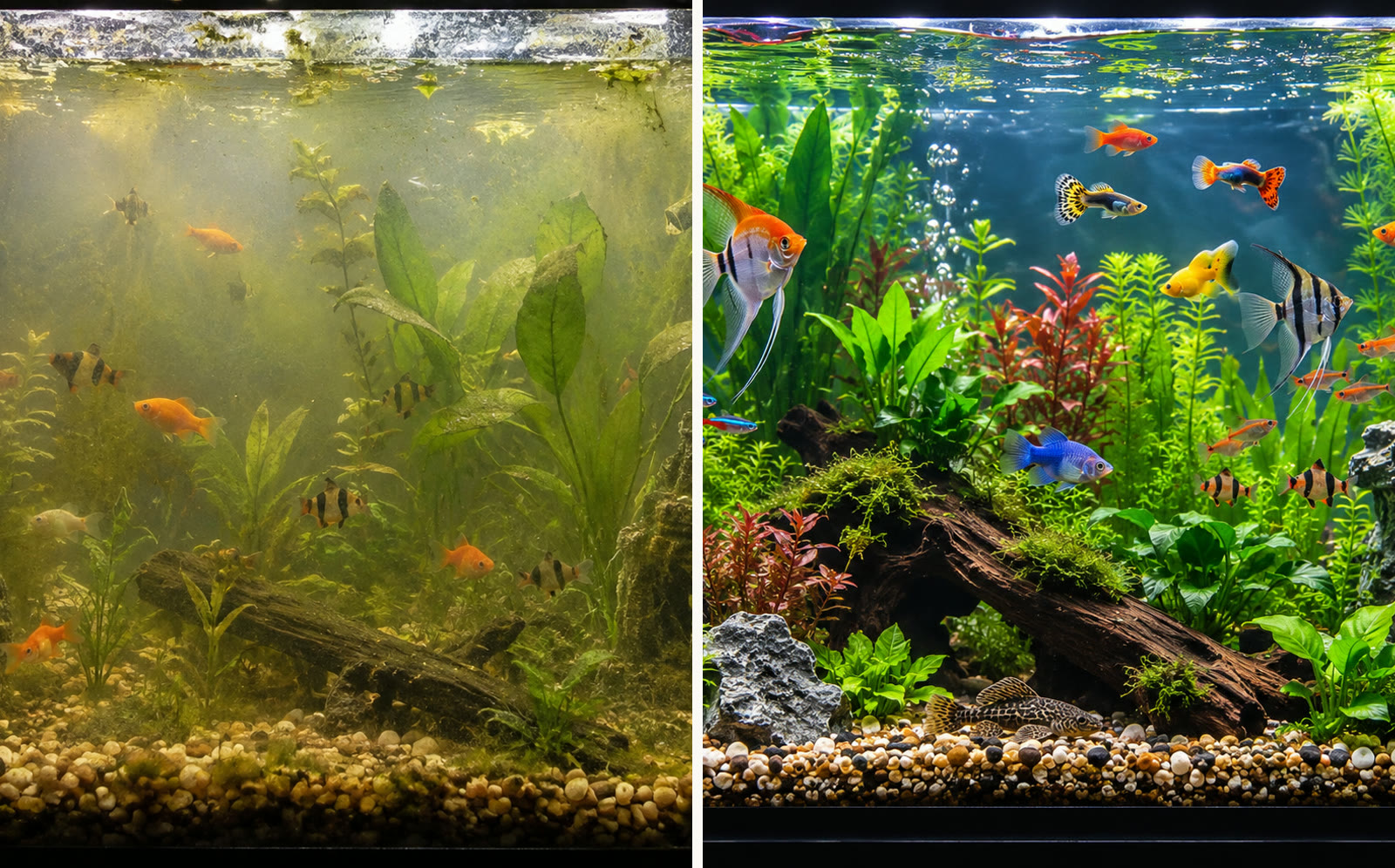
There is a story that explains almost everything we do at PurEarth, and it begins with a fish.
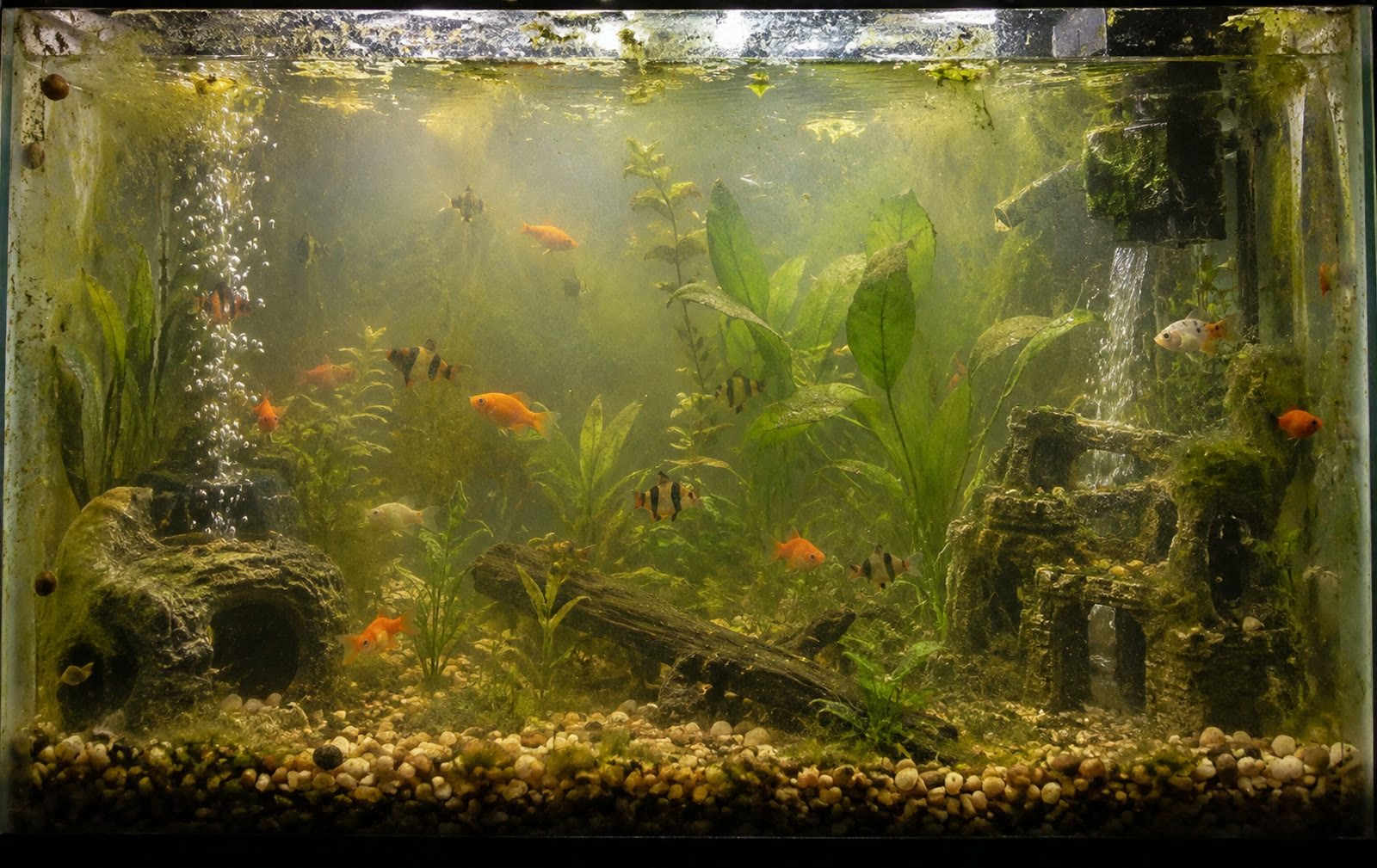
Imagine a fish in a neglected tank. The water is cloudy. Algae coats the glass. Oxygen runs low. Slowly, predictably, the fish gets sick.
There are two ways to respond.
You can treat the fish. Lift it out. Give it medicine. Return it to the same water. The symptoms may ease for a while. But the cause is still there, waiting. And in time, the fish gets sick again — because the fish was never the problem.
Or you can treat the tank. Clean the water. Restore the oxygen. Bring back the balance every living thing depends on. When the tank is clean, the fish thrives.
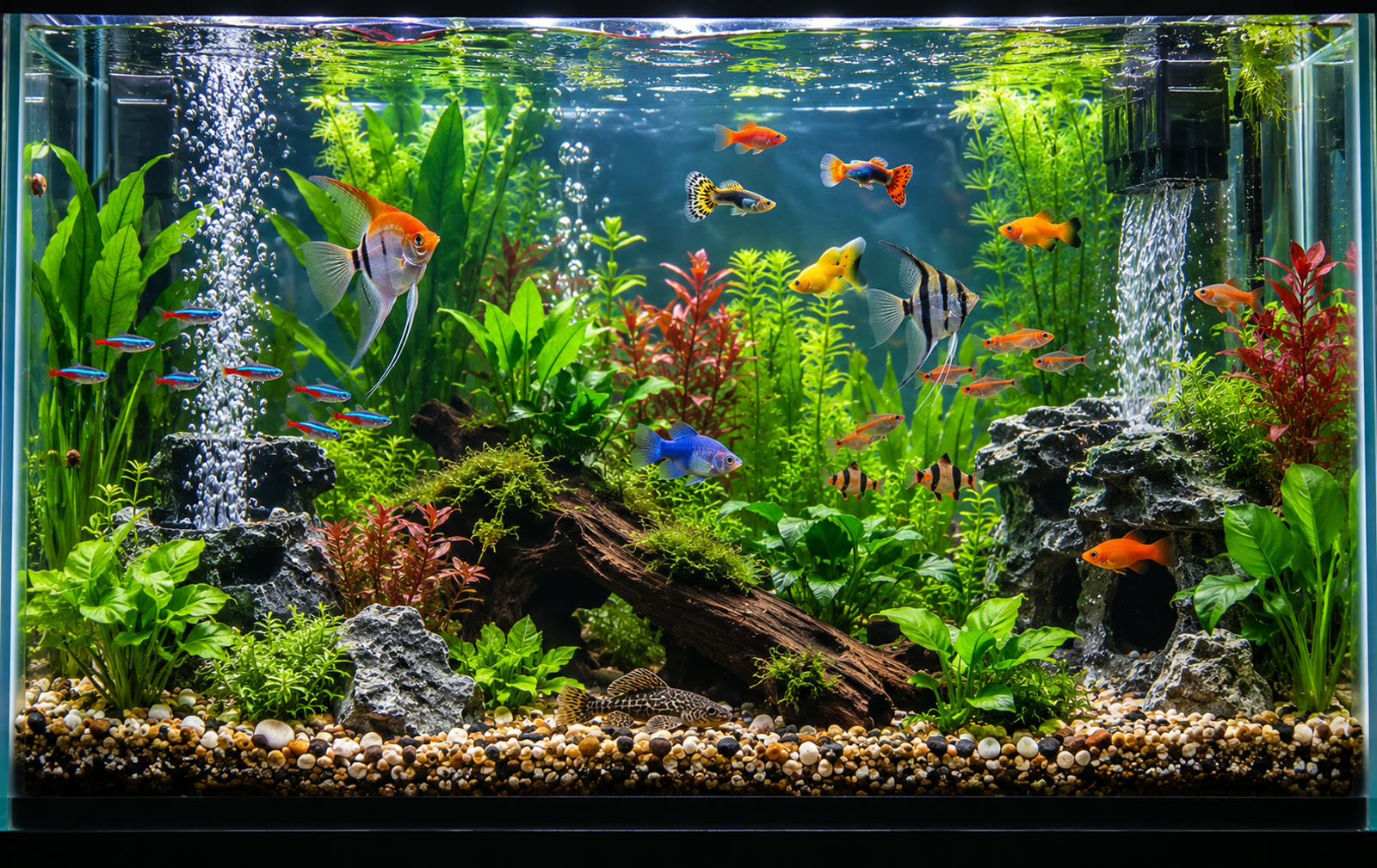
Both responses matter. This is not a story about choosing one over the other. The people who care for the fish do vital work, and a sick fish needs care. But lasting health cannot be built on a failing environment. You cannot heal the fish without cleaning the tank. And you cannot heal a person without restoring the environment they live in.
That is the whole argument. Everything else is detail.
The macro-terrain and the micro-terrain
Every living body exists inside two environments at once.
The first is the macro-terrain — the world outside the skin. The soil, water, air, and food supply. The economy, the infrastructure, the conditions of daily life. This is the environment we share.
The second is the micro-terrain — the world inside the body. The fluid surrounding every cell. The pH, the oxygen level, the nutrient balance, the electrical charge. This is the environment that determines whether a cell functions or fails.
The two are not separate systems. They are one continuous loop. The macro-terrain shapes the micro-terrain. When the water is contaminated, the cells that drink it are contaminated. When the air is polluted, the blood that carries oxygen is polluted. When the soil is stripped of nutrients, the food built from it is stripped of nutrients. The body does not get to opt out of the environment it lives in.
We have a habit of treating these as two different problems. Environmental health on one side. Human health on the other. Two causes, two budgets, two sets of experts. But they are not two problems. They are the same problem, seen from two ends.
- A toxic macro-terrain produces a sick micro-terrain.
- A clean macro-terrain produces a body that can heal itself.
The world’s leading health institutions are reaching the same conclusion
This is not a fringe idea, and it is not ours alone. The most respected health institutions on Earth have been moving toward it for a decade.
In 2015, the Rockefeller Foundation–Lancet Commission gave this idea a name: planetary health — the health of human civilization together with the natural systems it depends on. Not human health and environmental health. Human health as a function of environmental health.
More recently, four of the world’s leading bodies — the FAO, UNEP, the WHO, and WOAH — adopted a shared definition of One Health, an approach that treats the health of people, animals, and ecosystems as closely linked. One health. One system. One terrain.
The science is converging. The institutions are converging. What has been missing is the willingness to act on the conclusion at the scale where people actually live.
Heal the Earth, Heal Ourselves is our expression of that growing understanding — and our commitment to act on it, in communities, on the ground.
- 2015Planetary health named by the Rockefeller Foundation–Lancet Commission.
- One HealthFAO, UNEP, WHO, and WOAH adopt a shared definition.
- TodayHeal the Earth, Heal Ourselves: our expression of that understanding, and our commitment to act on it where people live.
The American sick care system
Look at how we treat the fish.
The American healthcare system is the most expensive in the world. We spend more per person than any other nation, by a wide margin. Yet Americans live to an average of just 79.8 years — while Japan reaches 85.1, Canada 83.1, and Germany 81.9. We pay the most and live the least.
This is not a failure of medicine. American medicine is excellent at what it does. The problem is what it is paid to do.
In a for-profit system, the incentive is to medicate the symptom and manage the disease. A healthy patient is a lost customer. A sick patient who never gets better is a customer for life — recurring revenue, guaranteed. No one in the system is motivated to ask the one question that matters most: why did this person get sick in the first place?
So we treat the fish. We manage the disease. We never clean the tank.
We call it healthcare, but it is not healthcare. It is sick care. It is a system built to manage illness after it appears, not to create the conditions where illness never takes root. It is broken — and it is so profitable that almost no one inside “the system” is motivated to change it.
But here are a couple of crazy ideas…
What if we paid for results instead of procedures?
What if we paid to reverse disease instead of maintaining it?
What if the goal were a healthy patient, not a returning one?
That question is where PurHealth begins.
The seed and the soil
There is a harder version of this argument, and it lives in oncology.
In 1889, a surgeon named Stephen Paget proposed what became known as the “seed and soil” hypothesis. Cancer, he observed, does not spread randomly. The seed may travel anywhere in the body, but it only takes root where the soil allows it. A fertile soil grows the seed. A hostile soil does not.
For a century, the hypothesis sat mostly unproven. Then modern oncology caught up. One of the most replicated findings in cancer research is that the tumor microenvironment — the terrain surrounding a tumor — determines whether cancer grows, spreads, or dies. Solid tumors are acidic and hypoxic. Low oxygen, low pH. Healthy cells thrive in the opposite environment: oxygen-rich, pH-balanced, nutrient-dense, electrically grounded.
This is the fish tank scenario again, at the scale of a single cell. The cancer cell is the fish. The cellular terrain around the fish is the tank.
Modern medicine targets the fish. It looks for the tumor, the virus, the pathogen, and attacks it directly with poison — radiation and chemotherapy. Although modern medicine claims this is necessary and that continuing cancer treatment saves lives, it is incomplete. Modern cancer therapy never asks the proper questions:
- Why did the terrain allow the disease to take root?
- Why was the soil fertile for the thing we are now fighting?
At PurEarth and PurHealth, we do not claim to cure cancer. No one honestly claims they can (yet — we are working on it). But we can ask a different question — what happens when we stop treating only the fish, and start restoring the tank?
What the science actually says
This is not philosophy. It is biology.
Every living cell on this planet — plant, animal, human — depends on the same five universal inputs:
- Water
- Oxygen
- Sunlight
- Nutrients
- Grounding into the Earth’s magnetic field
These five things create and sustain life. When any of them are impaired — when water is contaminated, when oxygen is depleted, when sunlight is blocked, when nutrients are stripped from the soil, when the body is disconnected from the Earth’s natural charge — the cell cannot function. It degenerates. Disease follows.
The mechanism is a loop, and it runs in both directions.
Downward: When oxygenation falls, mitochondria cannot produce ATP — the energy currency of the cell. When ATP falls, the cell’s ion pumps fail. Membrane voltage drops. Ion channels close. Waste accumulates. That waste makes the tissue more acidic and more hypoxic — which lowers oxygenation further. The loop tightens on itself. That is chronic disease.
Upward: Restore the oxygen, and the same cascade runs in reverse. Mitochondria resume ATP production. Ion pumps reactivate. Ion channels open. Waste clears. Inflammation falls. The tissue becomes more alkaline and more oxygenated — which supports even more ATP. The loop opens, and it accelerates.
This is where epigenetics enters the picture. Epigenetics is the study of how environment and lifestyle influence gene expression — turning genes on or off without changing the underlying DNA. Our genes are not our destiny. They are a control panel of potential instructions, and the environment is the electrician.
A toxic macro-terrain flips the switches for inflammation, disease, and degeneration.
A clean macro-terrain flips the switches for repair, immunity, and regeneration.
Our environment dictates our health. That is not just a slogan we use. It is a description of how the body actually works.
What the toxins are
If the tank is the problem, it is worth naming what is in the water.
- Pesticides and herbicides — glyphosate, Roundup, industrial weed killers
- Pathogens — viruses, bacteria, parasites
- Forever chemicals — PFAS, microplastics, heavy metals
- Industrial pollution — in the air, the water, the soil
- Electromagnetic interference — the constant hum of modern technology
- Processed food — nutrient-depleted, chemically laden, sugar-loaded
And not every toxin is chemical.
The environment also produces stress — chronic, unrelenting stress. The body was designed for short bursts of cortisol: the caveman fleeing the predator. The stress fires, the body responds, the threat passes, the system resets.
Modern life does not reset. Financial stress, marital stress, work stress, health stress — these are not momentary threats. They are permanent conditions. The adrenal glands respond the way they were designed to respond, by releasing cortisol. But instead of a burst, it becomes a baseline. Constant. Low-grade. Unrelenting.
Chronic cortisol suppresses immune function. It promotes systemic inflammation. It disrupts sleep. It impairs glucose metabolism. It shrinks the hippocampus. It accelerates cellular aging. It causes hormone imbalance and weight gain. The system built to respond to acute threats becomes the source of the chronic disease itself.
Not all stress is bad. Exercise is stress. Cold exposure is stress. Fasting is stress. The body responds to those positively — they make it stronger. The problem is the stress that never ends. The stress with no off switch.
That is the environment talking to your cells. And that is what has to be addressed.
Why treating one thing at a time fails
Here is where the fish tank analogy meets the real world, and where most well-intentioned efforts fall apart.
A water system fails when the power does. A clinic struggles when its patients cannot afford healthy food. A training program loses its graduates when there are no jobs to keep them. The essentials depend on one another. Fixing one while ignoring the others rarely lasts.
This is the mistake of treating problems in isolation. Build a well, and it works — until the pump breaks and there is no one trained to fix it and no grid to power it. Open a clinic, and it works — until the patients return to the same contaminated water and processed food that made them sick. Start a farm, and it works — until the soil is depleted and the water is scarce and the market is a thousand miles away.
The tank is not a collection of separate parts. It is a system. And systems have to be treated as systems.
That is why lasting change has to connect the essentials — water, power, food, materials, livelihoods, health — into one design, shaped around one place, built with the people who live there.
What it takes to clean the tank at community scale
This is the hard part, and it is where most environmental and health efforts stop. It is one thing to say “clean the tank.” It is another to do it for a town.
What it takes is a system. Not a project. A system.
A community needs clean energy that does not fail in a storm. It needs clean water that does not depend on a distant grid, a contaminated aquifer, or a fragile supply chain. It needs food that is grown nearby, year-round, in nutrient-dense soil. It needs materials that can be made locally from renewable crops. It needs high-paying jobs that keep young people from leaving. It needs healthcare that addresses root causes instead of managing symptoms. And it needs all of these things to feed each other — the waste of one becoming the fuel of another.
This is what we call the Sovereign Loop: a self-sustaining system where the output of one part becomes the input for the next. Water becomes hydrogen. Hydrogen becomes power. Power becomes water. Biogas becomes power. Power becomes fertilizer. Fertilizer becomes food. Food becomes waste. Waste becomes biogas. Hemp becomes batteries. Batteries become EVs. EVs reduce fossil fuels. Cleaner air heals cells. Healthier people demand more clean technology.
Nothing is wasted. Everything is connected. The system regenerates itself.
The word “sovereign” is not political here. It is biological. A cell that cannot regulate its own environment cannot survive. Neither can a community. Sovereignty, as we use the word, means resilience — the capacity of a place to meet its own essential needs, on its own terms, without relying on outside assistance.
When a community controls its water, its power, and its food, it controls the conditions its people live in. And the conditions its people live in determine how healthy they can be.
Both, not either
The story of the fish has two options, but the answer is not to pick one.
Treat the fish. Absolutely. Care for the sick. Fund the medicine. Honor the people who do that work, because it is essential and it is hard.
But do not stop there. Because if you never clean the tank, you will be treating the same fish forever — and wondering why it keeps getting sick.
The future we are working toward is one where both are true at once. Where healthcare is actually paid to reverse disease rather than manage it. Where the environment a person lives in is clean enough that the body can do what it was designed to do: heal itself. Where a community is sovereign over its essentials, and its people are healthy as a result.
You cannot heal the fish without cleaning the tank. And you cannot heal the human cell without restoring the environment it lives in.
The macro-terrain and the micro-terrain are not separate problems. They are the same system — two sides of one continuous loop.
Clean the tank, and the fish will heal itself.
Heal the Earth, Heal Ourselves.